

There’s probably no other subject with more varied opinions than how to best set up an airplane. Yet, if you could rank all the different setup methodologies based on results that were obtained within a four- or five-day time period, you’d quickly discover that certain setups promote faster rates of learning and have better results. This article features some basic setup rules that have proven to produce fast results.
RC pilots are constantly trying new setups that promise to improve their flying. If they could objectively evaluate their performance, they’d probably realize that in some cases, they actually flew better before. However, instead of returning to what worked best, they hope to overcome these new challenges with more practice. The tricky part of airplane setup is knowing what really helps, what sounds good in theory (but isn’t) and what may be applicable to some forms of extreme flying, but a detriment to most or all non-extreme flying.
BALANCE
Where you choose to balance your model will have a huge impact on how it handles in the air and how well you fly it. When an airplane pitches up or down, it pivots around a point on or near the wing’s thickest point. When the center of gravity (CG) is located at the wing’s thickest point (pivot point), the plane tends to be neutral, i.e., prone to doing only what you tell it to do. But, when the CG is aft of the pivot point (tail-heavy), the plane will tend to be unstable. Similar to shooting an arrow backwards, a tail-heavy airplane would be inclined to swap ends in flight were it not for the tail and the corrective inputs of the pilot. It’s true that a tail-heavy condition does increase maneuverability at the extreme ends of the flight envelope. As a consequence, however, the airplane requires a lot more effort to fly the rest of the time, especially at slower speeds when the tail forces are less than firm. A nose-heavy airplane tends to be very stable, less maneuverable and will behave differently depending on the speed. All things considered, a neutral CG location at the wing’s thickest point provides the best overall handling without restricting maneuverability.
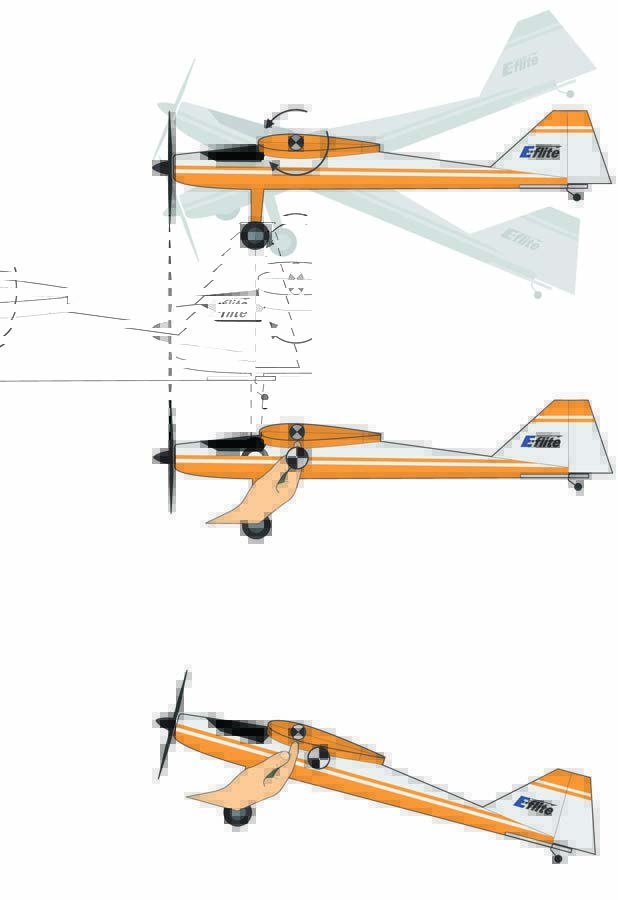
– As a rule, airplanes in flight pivot around a point (CG) on or near the wing’s thickest point.
– When the CG is neither forward nor aft of the wing’s thickest point, the airplane neither resists nor exaggerates what it is told to do and behaves basically the same at any speed.
– When the CG is aft of the wing’s thickest point, the airplane will be unstable at all speeds and require more effort to fly.
ENGINE THRUST
Setting up your airplane with engine right and down thrust will cause it to fly more true. This is because as the propeller turns, it produces a spiraling slipstream or prop-wash that ends up striking the left side of the vertical tail and tries to yaw the airplane to the left. Propwash is mostly held in check at higher speeds by the faster airflow over the tail. However, at lower airspeeds with high power, such as during takeoff or approaching the top of a loop, propwash has to be corrected by the pilot. Building in a couple degrees of engine-right thrust helps to counter the effects of propwash and reduces the demands on the pilot.
P-factor is a left-turning tendency that occurs when the airplane is at a positive angle of attack, due to the propeller blade of the right side of the plane biting more air and producing more thrust than the blade on the left side. By building in a couple degrees of down-thrust, you’ll place the propeller at slightly less of an angle to the relative wind and achieve a more equal bite on both blades during inside (up-elevator) maneuvers, which reduces P-factor. Another benefit of down thrust is providing a down force to counter excess wing lift when an airplane is flying at higher speeds, which is especially important with flat-bottom wing airplanes.
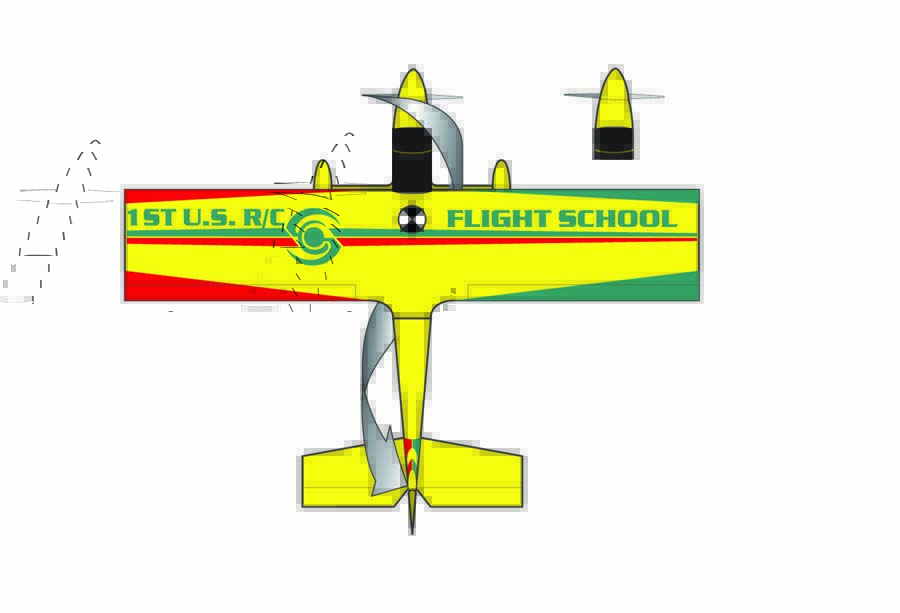
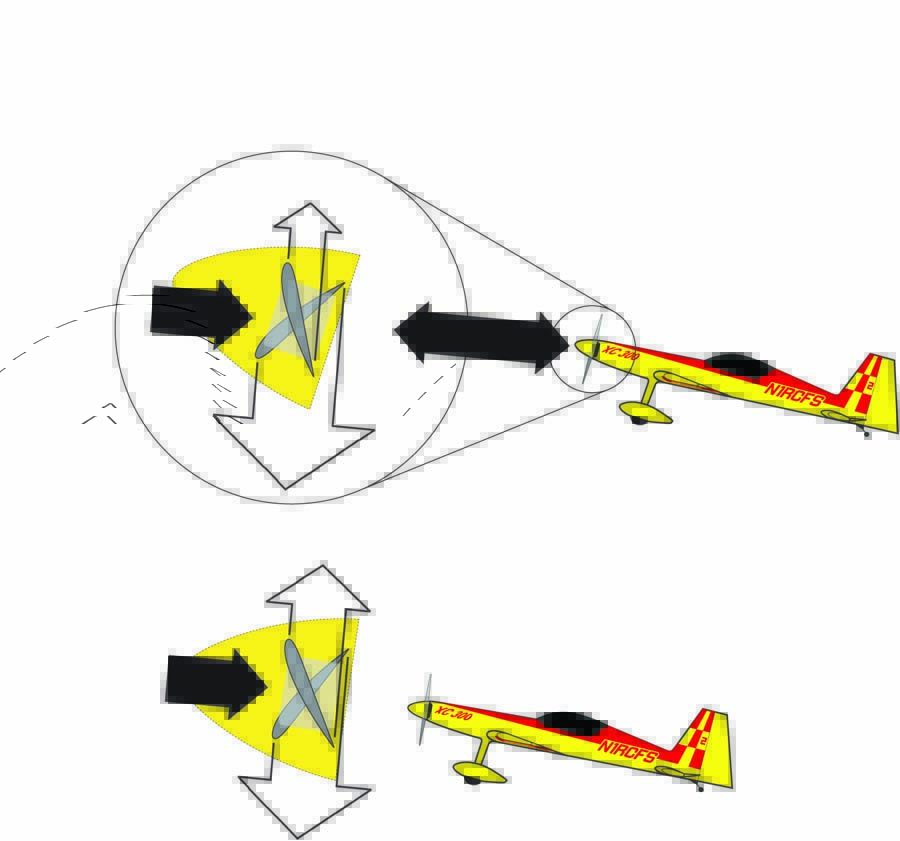
– At positive angles of attack, the propeller blade on the right side of the plane bites more air and produces more thrust than the blade on the left.
– Building in a couple of degrees of down thrust places the propeller at slightly less of an angle to the relative wind. This will achieve a little more equal bite on both blades during inside maneuvers.
CONTROL-SURFACE TRAVEL
As a rule, how an airplane responds to control inputs is a function of how fast and how far the control surfaces deflect, regardless of whether the airplane is large-, small-, high- or low-performance. You can seldom go wrong by initially setting up your control surface deflections/travels according to the manufacturers’ recommendations. However, be sure not to make the mistake of thinking those recommendations are what the manufacturer intends you to stick with. To fly your best, you must adjust the control-surface travels to suit your immediate skill level. By changing the travels to suit your comfort level, instead of worrying about getting used to the plane, you’ll immediately start flying with more confidence and begin building on that success.
When setting travels using a computer radio, it’s vital that you triple-check the physical deflections of all the control surfaces in all directions. For a variety of reasons, it’s often necessary to program different percentages to achieve the same physical travel of a surface in both directions. Every year, thousands of airplanes are faulted because their owners make certain assumptions based on the numbers they read off the transmitter, but then leave out the step of confirming all the physical deflections. They then either end up unhappy with the way their planes handle, or they assume that having to make numerous or large adjustments later is an indication of a poor design. Maybe all they have to do is program in more right than left aileron and they’ll find that the plane is just fine. Remember, transmitter settings should be based on actual deflections and your comfort level, not the numbers read off the radio. To minimize the need for adjustments and the potential for error, strive to set the neutral position and travel of each surface mechanically, and then use the radio only as a last resort to fine-tune things.
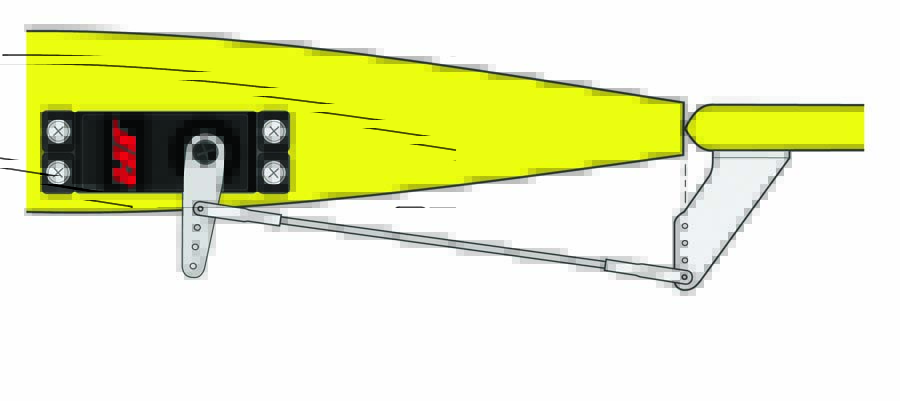
The optimal resolution setup for precision control and handling is achieved by connecting the pushrod to the hole closest to the servo and farthest out on the control horn. Just make sure that there isn’t any binding near the travel limits with this arrangement.
“BALANCED” CONTROLS
Another vital component of good flying is achieving balanced control responses. “Balanced controls” describes the ideal condition in which all the controls are equally sensitive. Other than a lack of control-stick tension, possibly nothing inhibits progress more than when one of the controls is noticeably more or less sensitive than the others. Even a novice pilot can tell when the ailerons are touchier than the elevator. Why would you accept one control that is more or less sensitive than the others when a simple control surface travel adjustment is all that’s needed to start feeling more comfortable?
AILERON/RUDDER MIXING FOR ADVERSE YAW
Adverse yaw is an inherent opposite yaw or slip that occurs with aileron deflections. A positive angle of attack is generally required to produce the wing lift needed to keep an airplane in the air. When the ailerons are deflected at a positive angle of attack, the down aileron presents a wider frontal cross-section, thus creating more drag and causing the airplane to yaw in the opposite direction that the ailerons are applied (figure 4). When two aileron servos and the flaperon function are used, adverse yaw can be lessened by programming a small amount of differential aileron travel, i.e., approximately five degrees less down aileron than up, improving control and producing cleaner axial rolls. The exception is when the airplane has a flat-bottom wing. The drag on the side of the down aileron and adverse yaw is so much more pronounced with a flat-bottom wing that differential aileron travel has little effect. To eliminate adverse yaw, rudder must be coordinated or mixed in the same direction with the aileron. As a rule, a symmetrical wing plane may require only a 3- to 5-percent rudder mix with the aileron to eliminate adverse yaw, whereas a flat-bottom wing plane requires nearly as much rudder deflection (in degrees) as aileron. Not only does eliminating adverse yaw improve control, but pilots who initially learn to fly with aileron/rudder mixing are also able to more easily transition into higher performance, symmetrical wing airplanes, as they are already accustomed to flying with minimal adverse yaw. Contrast that to those who learn to fly with adverse yaw, and then have to retrain their flying habits when they switch to a symmetrical wing plane with very little adverse yaw.
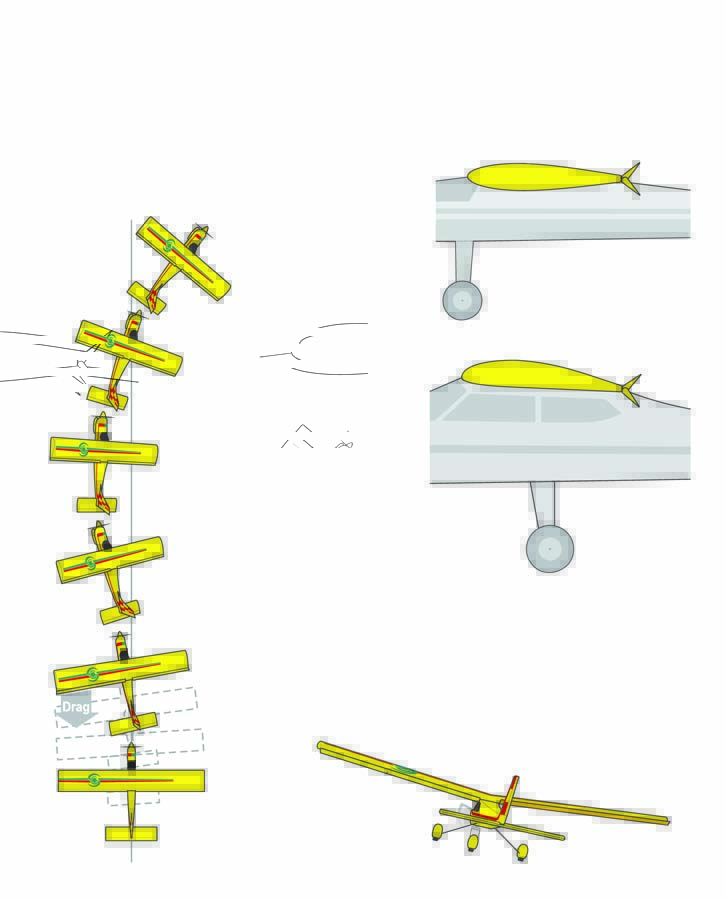
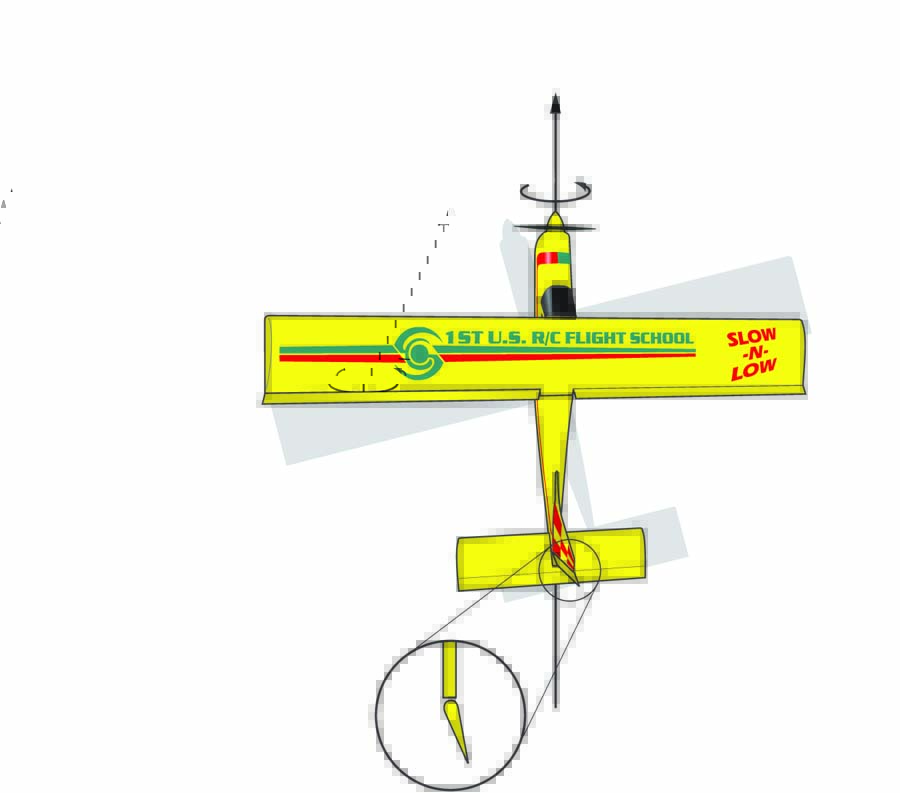
– In flight, the down aileron presents a wider cross-section, thus increasing drag and causing adverse yaw, i.e., a yaw in the opposite direction that the ailerons are applied.
ADVANCED DUAL RATES AND EXPO
Expert pilots are often asked to name their favorite aerobatic airplane. Frankly, once a person graduates to flying Edges, Extras, Sukhois, and the like, they are all equally capable, and any differences that are not setup-related are barely noticeable to all but the most expert fliers. The real question is: Will your airplane be set up to promote maximum success?
While not necessary for precision aerobatic flying, a computer radio with dual rates and exponential is required for 3D flying. That’s because the large control-surface deflections required for 3D maneuvers would cause an airplane to be far too responsive during normal flight. Dual rates allow a pilot to achieve optimal control response for different modes of flight. For example, high rates allow maximum travels for 3D flying, whereas low (normal) rates provide optimal control for precision aerobatic flying, takeoff and landing. To help you stay focused on flying and not on flipping switches, it’s recommended that you put all your dual-rate and expo settings on one switch.
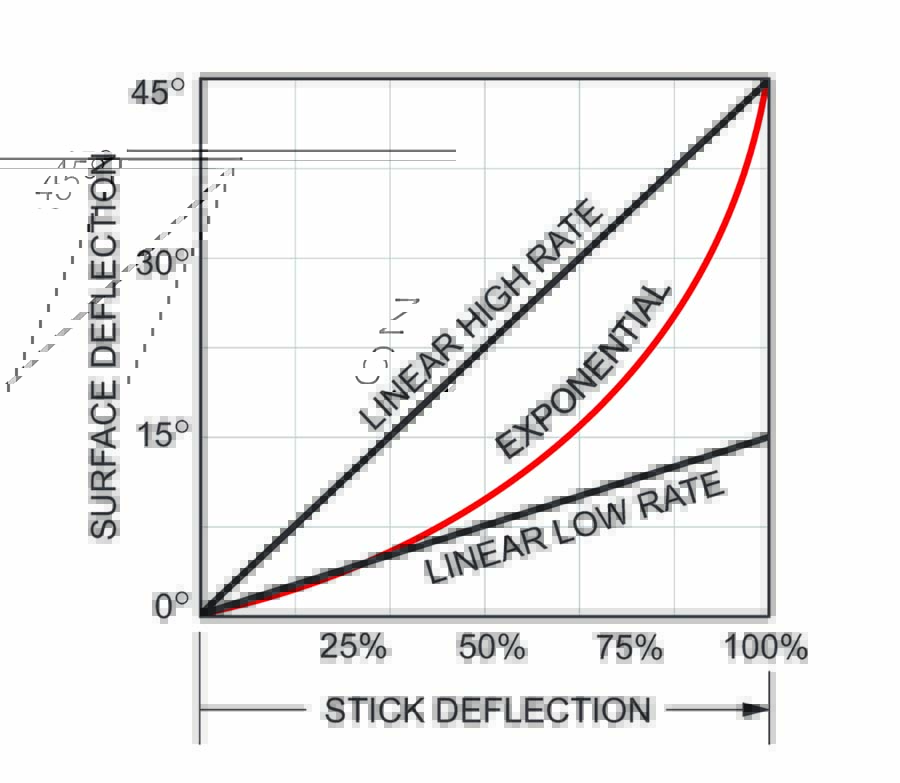
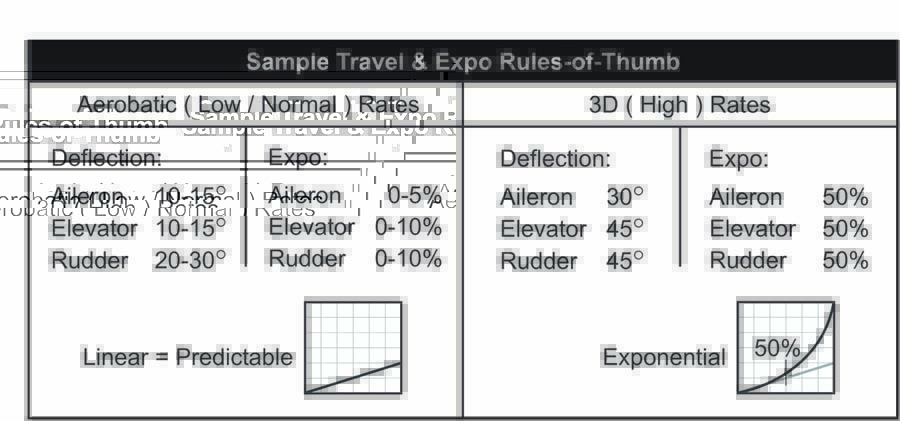
On high 3D rates, a plane will be too sensitive and hard to control between maneuvers, so 30- to 50-percent exponential is used to reduce control sensitivity through the first third or half of stick deflection. Expo will therefore allow you to fly with the “feel” of normal rates when the stick inputs are less than half, but then rapidly ramp up beyond that. However, to develop the precise timing required to fly aerobatics well, it’s important to maintain a close correlation between your inputs and the response of the plane. Therefore, the ideal low/normal rate settings should provide a comfortable control response with minimal use of expo. In other words, if the plane is touchy on low rates, before you start adding expo, you should first try reducing the low rate percentages.
MIXING RULES
For many reasons, every airplane exhibits some unwanted tendencies while maneuvering. For example, when a large amount of rudder is applied to sustain knife-edge flight, most planes tend to gently roll in the direction that the rudder is being held. Therefore, many fliers mix a small amount of opposite aileron with the rudder to cancel out the rolling tendency during knife-edge. However, if you’re thinking about using computerized mixing to minimize certain unwanted tendencies, you need to first understand that everything in aviation is a tradeoff. A mix that a pilot puts in may help the maneuver for which it is intended, but it may also turn out to be contrary to what’s needed during another maneuver. This may end up causing a deviation somewhere else that otherwise would not have existed and that’s why you must be very prudent with mixing.
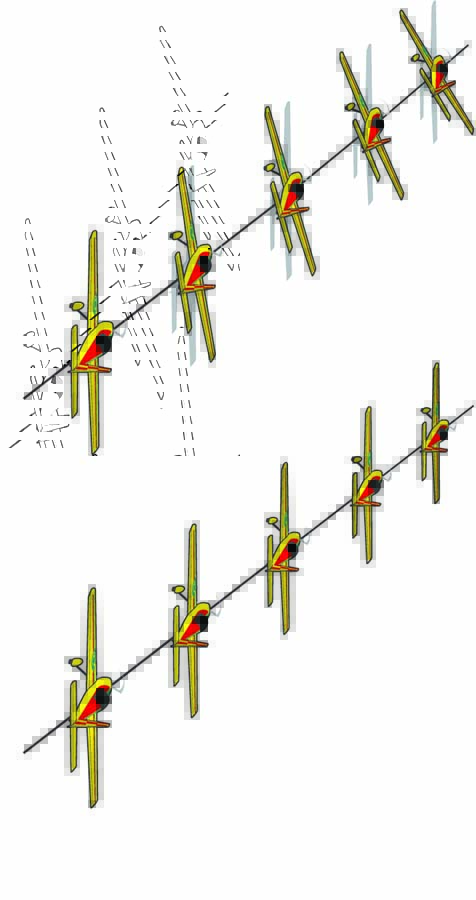
– Holding in left rudder during knife-edge flight results in the airplane also gently rolling left.
– Mixing a small amount of right aileron with left rudder cancels the roll tendency during knife-edge flight.
The process of mixing typically unfolds with a pilot detecting some negative tendencies during certain maneuvers that he then attempts to eliminate with different mixes. As more maneuvers are introduced, the pilot starts running into situations where the deviation that he wants to remove is actually caused by an earlier mix. The process that follows is hours of experimenting to determine which mixes stay, which need to be reduced, which need to be removed or reversed, and when it’s time to take the initiative to correct yourself. Therefore, unless you intend to only fly a few maneuvers, the most efficient and effective use of programmable mixes is to mix no more than 5 to 10 percent (15 percent max). Limiting your mixes to these percentages will hopefully make your flying easier without having too much impact on other maneuvers or causing you to do a lot of backtracking as your repertoire increases.
BOTTOM LINE
You can travel across the country and observe fliers involved in an endless cycle of trying to dial into their radios the corrections they could easily make by improving their flying skills. They have to keep repeating the process each time conditions change, a new maneuver grabs their interest, or they fly a different airplane. In many cases, it no longer even occurs to people that sometimes the simplest and most effective thing they could do to improve their flying skills is learn how to make the corrections. Mixes can prove very helpful, but nothing will have more impact on your flying than your skills.
TEXT & ILLUSTRATIONS BY DAVID SCOTT/RCFlightSchool.com
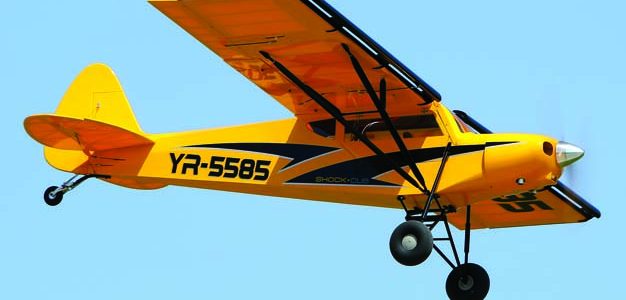
Photo by Raviation









Excellent Dave ! See you in May !
Rookie Grandpa Gary
Great article. Congrats